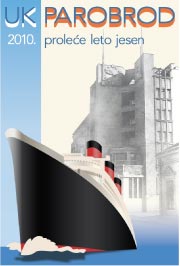
PAROBROD - MISIJA, VIZIJA I KONCEPT
"Parobrod" is a Cultural Center of the municipality of Stari grad in Belgrade.
MISSION Parobrod's mission is to produce, present, preserve and promote cultural events as well as other kinds of communication, interaction of cultural contents and forms, among the citizens of Belgrade, Serbia, across the region and even wider.
VISION Parobrod's vision is that not a day goes by without culture in the municipality of Stari grad and thus in Belgrade
CONCEPT Probrod's concept includes:
Polyvalence, when it comes to:
• activities - culture, art, creative industry, media, subculture
• creation, presentation and preservation of, both local and national, cultural heritage
• types of activities - permanent and temporary processes as well as permanent and periodic structures
• scope - interior, exterior, printed, electronic and digital media
Openness, to:
• participants and consumers of cultural creativity in all geographic definitions (Municipality, City, Region ...)
• creative individuals and groups, both established and unknown
• the general audience, members of different ethnic and religious groups, other minorities as well as vulnerable groups,
• different generations of participants and consumers of cultural creativity, and their interaction and exchange
• various partners : government sectors, NGOs, informal groups, the commercial sector ...
A Hub, for:
• meetings, creation and exchange of significant figures of the capital's cultural life,
• "great expectations" - introducing new names from different cultural spheres,
• intergenerational communication and interaction with synergistic effect,
• preparation and implementation of various projects and programs in various fields of cultural creativity.
Sustainability, in terms of:
• an optimal and flexible format based on the concept of mini-cultural centers,
• project-oriented organization of 10 employees,
• striving for diversification of financial resources(support of the municipality, the city of Belgrade and government sectors, citizens' donations, program and project sponsorship, corporate social responsibility, commercially viable projects and programs ...)
Parobrod ("The Steamboat"), even though at the beginning of its journey, is already "sailing" in various directions:
• "mapping" available human and infrastructural "resources of culture" (for example, the establishment of the Program Council, or the mapping of cultural spots in the Municipality)
• further actions (for example, the formulation of Parobrod's cultural strategy and its program)
• preservation and enhancement of quality and sustainability of the existing programs (for example, BITEF Polyphony or workshops for young people ...)
"The culture of partnership", "Experience for takeaway", "Culture for the Neighborhood", "Open cultural scene", "New tendencies and trends", "International cooperation» ...)
Parobrod's objective is to be the hub for culture, a cultural "propeller" constantly producing new waves, flows and whirlpools.
The First Danube Steamboat Society
Center for Culture "Stari Grad"
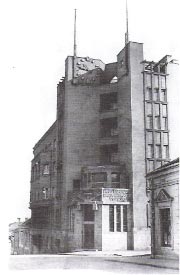
The building was built in 1925 as one of the first buildings in the spirit of modern architecture
This multistory residential and office building is on the corner of Jevremova and Kapetan Misina Street. It has entrances from both streets and another one on the corner which was once, in the former Kingdom of Serbs Croats and Slovenians, the entrance to the headquarters of the famous Austrian Danube Steamboat Society D.D.S.G., known as “Dunavac . The building was designed by an Austrian architect Alexander Pop, assistant to the famous Peter Behrens. The designs were developed and slightly edited by a Serbian engineer Stevan Toblar .
Motivated by the kind of work the company he designed for was doing, the author brought forms into his designs which symbolically remind us of a steamboat. Two stacks, masts and an anchor were used as a stylized emblem of the Society. The building also has a large clock. In the backyard there is a small angular house/garden made of glass (which has been converted into a residential unit). It is one of the first houses built in the spirit of the late Viennese Secession and Czech Cubism, modernism without ornaments, with a dominant rhythm of horizontals and verticals. Today, beautifully restored, this building is the pearl not only of Jevremova Street but the whole of Belgrade. Inside the building there is an elevator, it was the first one ever built in Jevremova Street and most probably one of the first elevators in the city. Among people who lived in the street the building was known as “The Hungarian House”. During the occupation the German Red Cross was stationed here. After the II World War the building was the headquarters of the Black Sea Fleet Command and for a period of time it was the Swiss embassy.
The earliest tenants of the building were the descendants of writer Jelisaveta Markovic - our skilled translator, her son Bozidar and daughter Lepuska -both university professors, and the granddaughter of Milos-a lowyer and a famous representative water polo goalkeeper. Actress Vuka Dundjerovic and Pavle Jevremovic a longtime diplomat in the United Nations also lived in the building as well as journalist and fashion designer Marija Kranjc, director Nikola Veselinovic and orthopedic surgeon Vladimir Lalosević. Pavle Beljanski(1892-1965) a diplomat who lived here and left his priceless collection of Serbian art (paintings, drawings, sculptures, furniture, documents), collected between the two wars. The collection is now in Novi Sad.
The building also housed the Center for Culture "Stari Grad" - a symbol of modern culture in the area.
According to the book: The Street of our ancestors-Gospodar Jevremova
by Dobroslav Bojko St. Pavlovics